Details
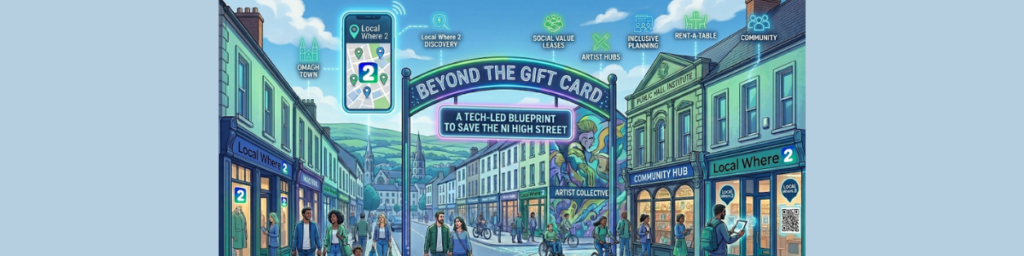
Can we save the NI High Street? It’s about a shift in perspective. Discover how Northern Ireland can learn from ‘Shop Share’ models in Manchester and London, and how Local Where 2 uses technology to bring awareness back to our town centres.
For decades, the Northern Ireland High Street was the social glue of our communities. However, walking through many of our towns today, the "disintegration" is visible. Boarded-up windows are signs of a lost community pulse.
While "Shop Local" gift cards are a great start, a card in a wallet doesn't tell a story. This is where Local Where 2 comes in. We are the technology layer that makes our high streets "discoverable" again. We provide the platform where businesses showcase their jobs, events, and unique offerings so the community actually knows they are there.
The Research: Lessons from the "Experience Economy"
To fix our streets, we must look at where the "remedy" is actually working. Our research into England's high street recovery reveals two major shifts:
1. Manchester & the Withington "Pop-up" Success
The Institute of Place Management (IPM) in Manchester has proven that high streets thrive when they stop being 100% retail and start being multi-functional.
- The Withington Case Study: In Withington, Manchester, they used "tactical urbanism" to fight vacancy. They turned a former NatWest Bank vault into a pop-up pub called The Lock Inn and hosted a makers' market called The Curiosity Collection.
- The Result: These weren't just temporary fixes. The research shows these pop-ups led to permanent residencies. The market now occupies a shop full-time, and the organisers eventually renovated a disused working man's club to create the permanent Withington Public Hall Institute (WPHI)—a non-profit community hub that survives on footfall and local love.
- Stockport’s "Experience" Hub: Nearby in Stockport, a £7m investment into the "Underbanks" area focused on the Experience Economy, restoring historic shopfronts to house independent bakeries, bars, and "Shop Share" collectives.
2. London’s Social Value Strategy
In London, the Good Growth Fund and councils in Tottenham and South Norwood are moving away from "highest bidder" leasing toward Social Value Leases.
- What is Social Value? It’s the idea that a business’s worth isn't just the rent they pay, but the benefit they bring to the community.
- The Strategy: If a business hosts youth workshops or mental health meetups, that "social value" is recognised. Instead of just leasing to the highest bidder, councils are supporting "meanwhile use" for artists and community groups to keep the street vibrant.
The NI Application: Bridging the Gap with Tech
We have to talk about the elephant in the room: Business Rates. As of early 2026, the NI Finance Minister has halted the "Reval2026" process due to immense pressure from our hospitality and retail sectors. Businesses are at a breaking point.
Technology isn't a magic wand that pays the bills, but it is a survival tool. If a local shop in Enniskillen or Newry wants to try a "Withington-style" pop-up or host a local artist to increase footfall, Local Where 2 provides the digital stage to ensure the town actually sees it. We need to stop looking at regeneration as a "numbers game" played by people in boardrooms.
- Repurposing for Art: Look at Belfast’s "Vacant to Vibrant" scheme. It has successfully moved groups like the Array Arts Collective into empty units. We need this scaled to every town in NI.
- A Seat at the Table: We are calling for disability representation on every planning committee. If our high streets aren't physically accessible, they aren't inclusive.
- Listen to the Community: Communication must be a two-way street. Decision-makers need to listen to the small business owners who are actually on the ground every day.
The Vision: Let’s use technology to showcase our local talent and use policy to make our buildings work for the people.
Frequently Asked Questions
Towns can adapt this by repurposing vacant historic buildings, like old banks, into multi-use hubs. By focusing on "Experience" (pop-ups and markets), we drive footfall that traditional retail alone no longer attracts.
This is an agreement where a business’s rent or rates are adjusted based on the community value they provide, like hosting workshops. It encourages councils to prioritize community impact over the highest bidder.
A high street that isn't physically accessible isn't truly public. Having disability advocates on planning committees ensures projects are welcoming to everyone, which increases the total number of people visiting our towns.
View the business